No. 02 — AI UX Auditor
An agent that finds UX and accessibility bugs on a live site, fixes them, and proves each fix worked.
The problem
Audits are manual and late, scanners skip menus and modals, and nobody checks that a fix actually fixed anything.
What I built
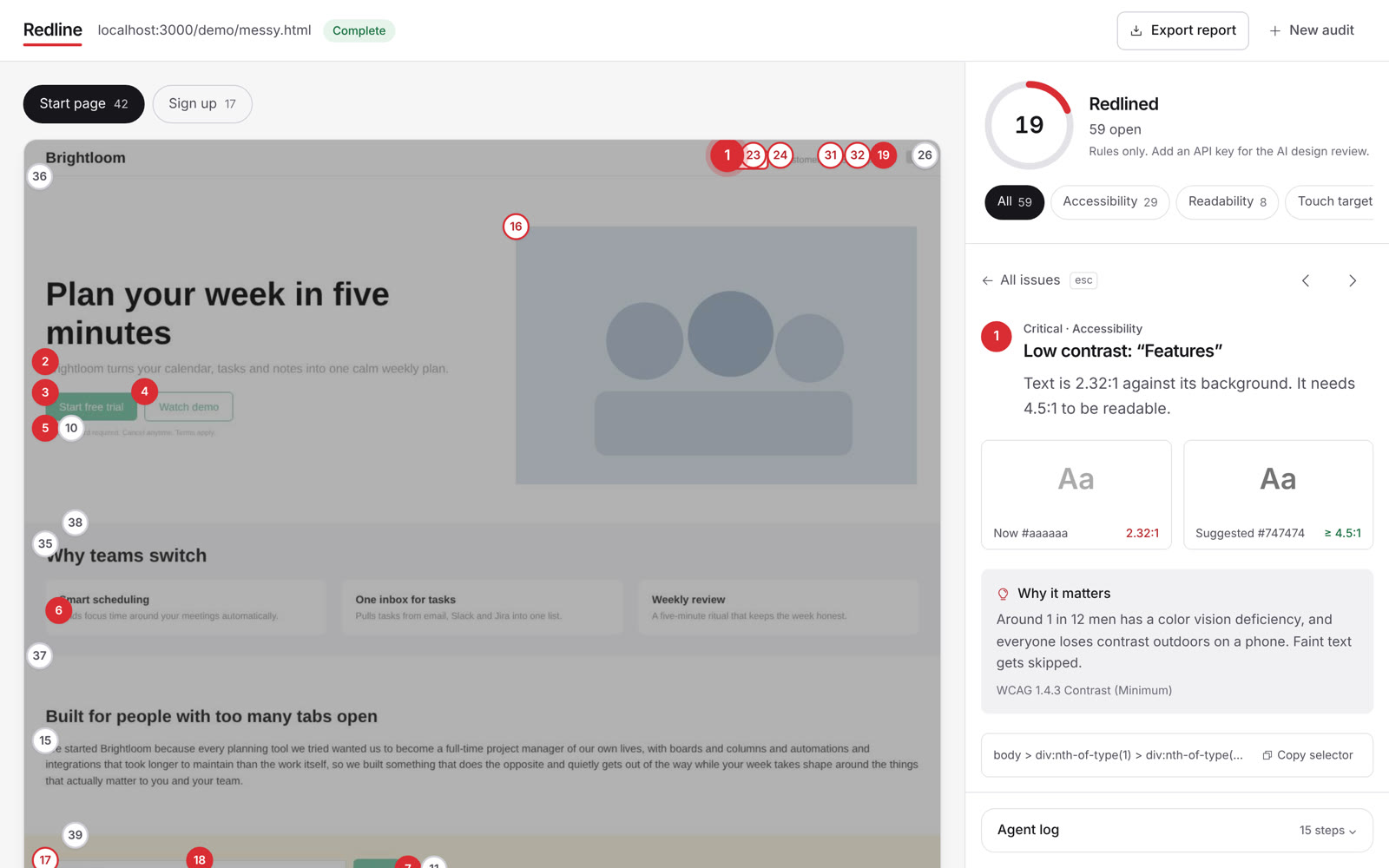
A Playwright agent that walks real user flows, opens pop-ups, pins issues, applies fixes and re-checks them before exporting a patch.
The result
54 of 54 auto-fixes verified on the demo site, and the accessibility score went from 17 to 50 in one pass.
01See it work
 Demo video coming soon
Video coming soon: 2-minute walkthrough: paste a URL, watch the agent audit, fix and export.
- 54/54
- auto-fixes verified after re-render
- 17 → 50
- accessibility score on the demo page
- ~13s
- to audit 4 views and find 70 issues
- 22% → 1%
- false visual change after row alignment
02Why it matters
Accessibility audits happen at the end of a project, by hand, from a checklist. Automated scanners help, but they only look at the page as it loads. The worst bugs are in menus, modals and checkout steps that nobody opens. And when a tool suggests a fix, you're left to find out on your own whether it worked or broke the layout.
03The idea
I treated auditing as an agent loop with a verifier: detect, fix, re-render, re-check. A fix only counts if the agent can prove it in a real browser, so every claim in the report has evidence behind it.
04How it works
- DeterministicPaste a URLStart from any live page
- DeterministicWalk & openPlaywright follows sign-up, login and checkout flows and clicks open menus and modals
- AI modelDetectRule engine plus an optional Claude vision pass
- AI modelFixApplies a candidate fix in a sandboxed browser
- Verification gateRe-checkRe-renders the page, re-runs the rules and diffs the layout
- OutputExportJS/CSS patch, HTML report and issue list
05Decisions that mattered
Prove it, don't just suggest it
Fixes are applied and re-tested in Redline's own browser. Only the verified ones end up in the exported patch, which reproduces 54 of 54 fixes on its own.
Open the hidden layers
The agent finds likely triggers, opens each pop-up and checks it as its own view: focus moves in, Esc closes it, and focus returns afterwards.
A diff that understands layout
A naive pixel diff reported a 22% change for a one-line fix. Aligning page rows with banded Needleman–Wunsch first cut that false change to about 1%.
Fixes that don't move the page
Tap-target fixes use padding plus a negative margin, so surrounding content moves 0px. That's asserted in tests, because reflowing a client's layout is a bug too.
06How I know it works
A smoke suite runs against a seeded demo site: 16 known rule types, 2 pages and 2 pop-ups. A real university site exposed a contrast bug (white text over a photo was 'fixed' to grey), which is now a regression test.
16/16 seeded issue types are caught. Next is a labeled set of ~50 real screens, scored against axe-core for precision and recall.
07What's next
- "Open PR" mode: map each fix back to the source component
- Labeled eval set with precision/recall against axe-core